
This insight marked the beginning of our work with Linda, our local AI assistant for inside. Linda is designed to answer questions about inside—not based on general model knowledge. Not from assumptions. But based on the inside Compendium.
At first, this sounds like a technical project. In fact, it turned out to be primarily a project about knowledge work.
Because it quickly became clear: AI doesn’t simply need more content. It needs well-structured, categorized, and verifiable knowledge.
The inside Compendium as a Starting Point
The inside Compendium is our handbook for knowledge work with inside.
It describes how knowledge management can be implemented in practice within companies and organizations: with clear terms, roles, methods, principles, and relationships.
This compendium has already been helpful to people. People can read longer texts, establish connections on their own, and mentally fill in missing context.
That’s not enough for an AI.
An AI doesn’t work with an entire handbook in its head. It receives selected excerpts as context for a given question. That’s why every excerpt must be as clear as possible.
- What is the statement?
- To what does it apply?
- In what context does it appear?
- What question can it answer?
The compendium thus became a knowledge base.
Sections: Breaking Knowledge Down into Clear Units
The first important step was segmentation.
We divided the compendium into sections. A section is not simply a paragraph. It is a technical unit with a clear purpose within the chapter.
For example, a section can explain:
- why a topic is important,
- what a term means,
- how a relationship works,
- what role an element plays in the flow of knowledge,
- what common mistakes arise,
- what reflective question helps when applying the knowledge to one’s own practice.
This structure wasn’t merely a matter of format. It became a quality check.
Because as we broke it down, it became clear where content was still trying to cover too much at once. Some sections explained multiple ideas simultaneously. Some terms were used but not properly introduced.
Some relationships were understandable to people but not clear enough on their own.
For Linda, that was precisely what mattered.
If a section is later used as context for an answer, it must be robust enough to make sense even outside the context of the entire chapter.
The inside Knowledge Stack as a Coordinate System
In the next step, we mapped the content within the inside Knowledge Stack.
The inside Knowledge Stack describes how knowledge is conceived and structured within inside. It shows the levels at which knowledge is generated, organized, applied collaboratively, and leads to decisions.
We distinguish six levels:
- Knowledge and Information
- Semantic Layer
- Governance and Standards
- Collaboration and Culture
- Impact and Development
- Ecosystem and Roles
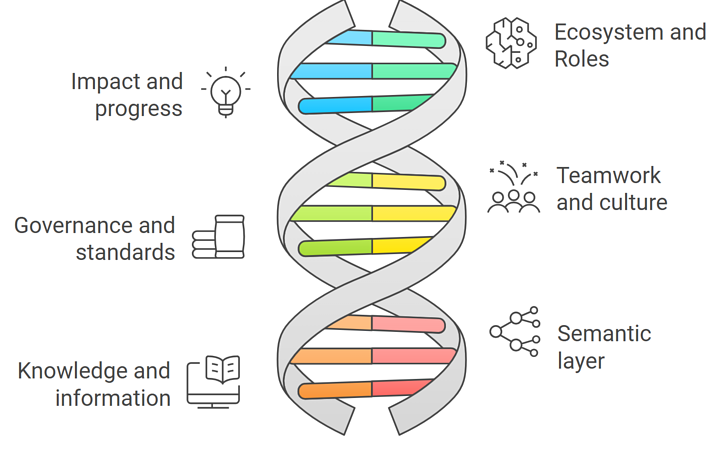
These levels help classify knowledge not only thematically but also functionally.
This is important because a term can have a different meaning depending on the context.
An example:
The question “What is a domain?” can refer to different things.
- Is it a defined area of knowledge?
- Is it about access and sharing?
- Is it about teamwork?
- Is it about roles and responsibilities?
For humans, this distinction is often self-evident. For an AI, it is not.
That’s why Linda needs guidance on which semantic space to search.
The Knowledge Stack provides the Compendium with these coordinates.
Embeddings and Vector Map
To enable Linda to find relevant content, the sections are stored as embeddings.
An embedding is a semantic profile of a text. This profile is generated by an embedding model. It consists of many numerical values and describes patterns of meaning, context, and usage.
Texts with similar meanings receive similar semantic profiles. These profiles can be compared with one another in a vector space. This makes it possible to calculate which sections are semantically close to a given question.
Our vector map visualizes this space.
It does not show the compendium as a table of contents. Nor does it show the chapter structure. It shows proximity, distance, and clusters.
This allowed us to see:
Which sections are closely related in terms of subject matter?
- Which pieces of content form clear groups?
- Which chapters are well-positioned?
- Which semantic groups overlap?
- Which pieces of content stand alone?
The vector map is not an absolute truth. It is a projection of a complex semantic space into a visual representation.
But it became an important editorial tool for us.
Because isolated points raise questions:
- Is this content really an exception?
- Is it worded too generally?
- Does it mix several ideas?
- Is a connecting term missing?
Or is an explanatory intermediate step still missing from the compendium?
In this way, the vector map became a mirror of the knowledge base.
The question is assigned a location
It’s not just the sections that can be represented as semantic profiles. A question can also be categorized in this way.
In our vector map, we mark a specific question with a star.
The star shows where the question lands within the knowledge space of the inside Compendium.
This helps during review:
- Is the question close to relevant sections?
- Does it relate to the correct semantic group?
- Does it belong to the expected chapter?
- Or does it end up in an area that only sounds linguistically similar but doesn’t fit thematically?
This step is important because retrieval shouldn’t be based solely on word similarity. Linda shouldn’t just find anything similar. She should find the appropriate context.
Intent Recognition: What Kind of Answer Is Being Sought?
Another important step is intent recognition.
Intent means: What is the underlying purpose of a question? Not every question seeks the same kind of knowledge.
“What is a domain?” is likely looking for a definition.
“Why are domains important?” is looking for a rationale.
“How do I set up a domain effectively?” is looking for a procedure.
“What are the responsibilities of domain managers?” is looking for a role-based perspective.
The terms may be similar, but the expected answer is different. That’s why it’s not enough to simply find semantically similar sections. Linda also needs to know what kind of context is required for the answer.
A definition requires different sections than a set of instructions.
A reflective question requires different units of knowledge than a navigational question.
A strategic classification requires different contextual relationships than a brief clarification of a term.
Intent recognition helps steer the search more precisely.
Prompt + Context = Answer
Ultimately, Linda’s answer is composed of two building blocks:
Prompt + Context = Answer.
The prompt is the set of instructions.
It specifies:
what role Linda plays,
how she should respond,
what limits apply,
which sources she is allowed to use,
what should happen if context is missing.
The context is the retrieved knowledge.
For Linda, this context comes from the internal compendium. These are the sections that match the question and form the context for the answer.
Without context, Linda would only generate linguistically plausible answers.
Without a prompt, Linda would have material, but no clear rules.
Only when both are combined does the answer become verifiable.
That is the crucial difference between an impressive AI answer and a reliable one.
An answer is impressive when it sounds good.
An answer is reliable when it is clear what it is based on.
The Boundary as a Quality Feature
A central part of our work was the question:
What should Linda do if sufficient context cannot be found?
Our answer is clear:
In that case, Linda should not invent an answer.
She should make it clear that the context is missing.
For example:
“There is insufficient context for this in the compendium.”
That sounds unspectacular. But for knowledge management, it is crucial.
After all, in organizations, not every plausible answer is also a valid answer.
A reliable AI must therefore not only provide good answers; it must also know when it must not answer.
This is precisely where the value of a structured knowledge base becomes apparent. Every unanswered question becomes a clue:
- Is a term missing?
- Is a connection missing?
- Is an example missing?
- Is a role-based perspective missing?
- Or is the content present but not structured well enough?
In this way, Linda becomes more than just an assistant. She also becomes a tool for the further development of the compendium.
Open Source as the Next Step
The project is set to become open source.
Planned components include:
the Rails app,
the embedding service,
the RAG service,
and the Docker setup.
Not as a ready-made miracle solution, but as a tool, a learning path, and an invitation.
Our goal is to demonstrate how organizations can organize their own knowledge so that AI can work with it reliably.
Because AI readiness doesn’t start with AI. It starts with the quality of an organization’s own knowledge.
Conclusion
For us, Linda is more than just a local AI assistant. She is a litmus test for knowledge work. She shows where concepts are clear, where context is missing, where knowledge is well-connected, and where the compendium needs further development.
Our most important insight is:
AI does not render knowledge management obsolete.
AI reveals whether knowledge management is working.